

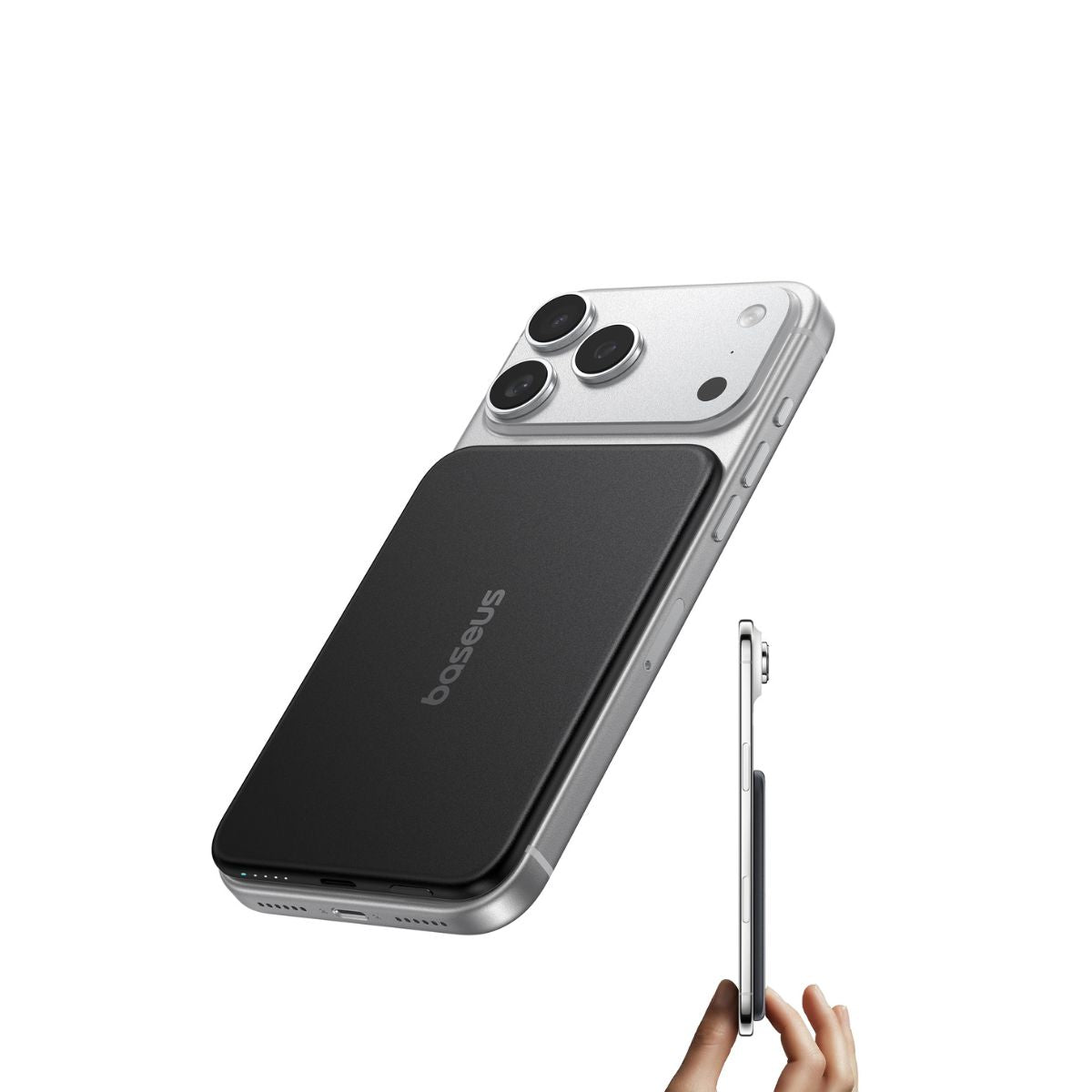
Quick answer: The Baseus PicoGo Air AM71 is a 5,000mAh magnetic power bank built around portability and battery transparency. It is 6.9mm thick, supports up to 22.5W USB-C output, and uses NFC with the Baseus app to show charge level, temperature, usage time and battery health. Its main limitations are modest wireless charging speed, snapshot-only NFC readings and top-up rather than full-recharge capacity.
At the Baseus Malaysia office, I asked a simple question: how can power banks continue to innovate?
Capacity is no longer enough on its own. We already have power banks with faster charging, more ports and larger batteries. The person in charge answered by showing me the Baseus PicoGo Air AM71, an ultra-slim magnetic power bank with a less obvious but more interesting idea.
It lets you check the health of the power bank itself.
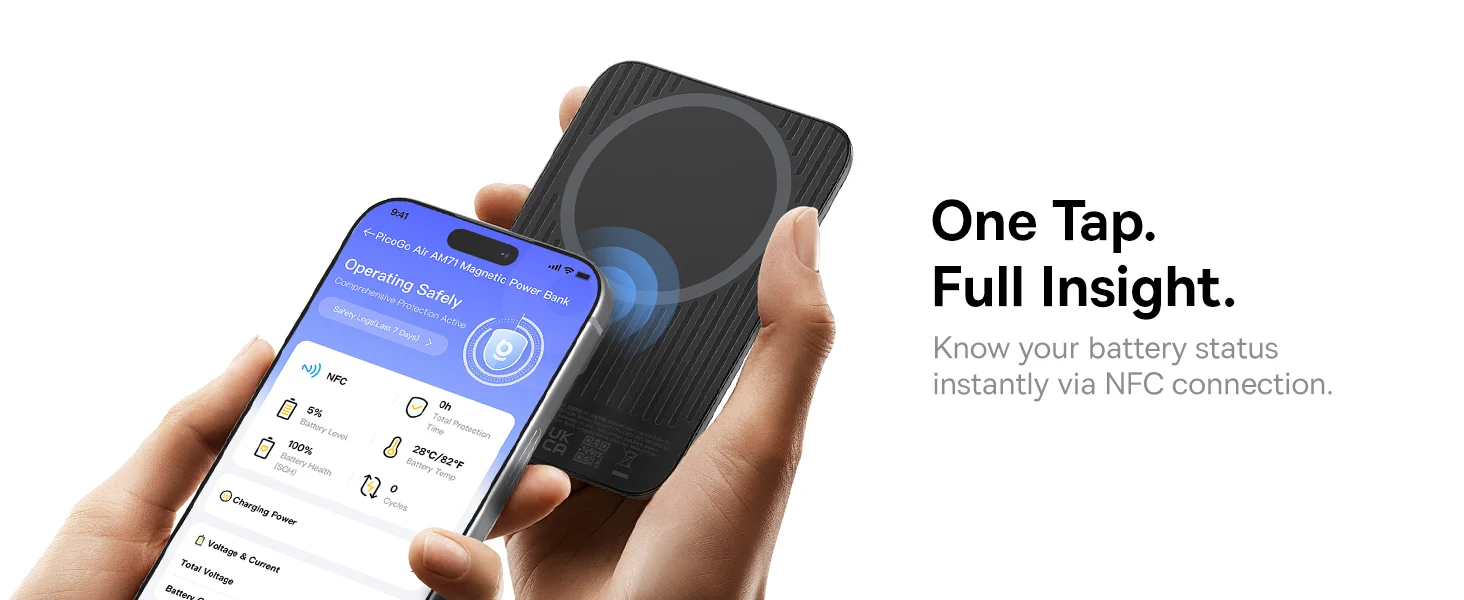
Tap a compatible NFC phone against the marked area, open the Baseus app and the AM71 can show its remaining charge, temperature, total usage time and state of health. Battery percentage is useful, but battery health is the more important long-term measurement. It gives us visibility into something most power banks keep hidden: how well the internal battery is ageing.
After trying the product in person and comparing the experience with independent tests, I think that is the AM71’s strongest feature. This is not the fastest or highest-capacity magnetic power bank available. It is, however, one of the few that helps the owner understand the condition of the battery they carry every day.
Baseus PicoGo Air AM71 specifications
| Feature | Specification |
|---|---|
| Capacity | 5,000mAh / 19.4Wh |
| Thickness | 6.9mm claimed; approximately 6.8–7.0mm in independent measurements |
| Weight | Approximately 104–105g |
| Wired output | Up to 22.5W through USB-C |
| Power-bank input | Up to 20W through USB-C |
| Magnetic wireless charging | Up to 15W on compatible Qi devices; 7.5W reported for iPhone charging |
| Smart feature | NFC PowerSense with Baseus app |
| App information | Remaining charge, battery temperature, total usage time and state of health |
| Colours | Black, Silver and Dark Cherry |
The official Baseus product page lists a 5,000mAh capacity, 22.5W wired output and NFC PowerSense integration. This article concerns the 5,000mAh PicoGo Air AM71, not the newer 10,000mAh AM71 Qi2.2 variant that appears alongside it in some marketplace listings.
NFC is useful because the important information is normally invisible
Most power banks communicate through four LEDs. They tell you that the unit is roughly full, three-quarters full, half full or nearly empty. That is enough for the next charge, but it says nothing about the condition of the battery after months or years of use.
The AM71 uses NFC PowerSense to expose more information through the Baseus app. An independent Notebookcheck test found that tapping the pack against a phone opened the app and displayed charge level, battery temperature, total usage time and state of health, or SoH.
That distinction matters. Charge level tells you how much energy is available now; battery health estimates how much of the original capability remains as the cell ages. A power bank may still show 100% after charging while holding materially less usable energy than it did when new.
Being able to see battery temperature is also useful. Heat is one of the factors that accelerates lithium-battery ageing, and a magnetic wireless power bank sits directly against the back of a phone while both devices generate heat. The AM71’s reading is not a substitute for proper testing or a guarantee of safety, but it gives the owner more evidence than a row of LEDs ever could.
There is one important limitation: this is not continuous live monitoring. Notebookcheck found that the information had to be refreshed by tapping the NFC area again. You also need the Baseus app and a Baseus account to access the detailed data. The power bank works normally without the app, but the battery-health feature does not.
In other words, NFC is not transforming the AM71 into a permanently connected smart device. It is a convenient tap-to-check diagnostic tool, and that is still genuinely useful.
Battery health should become a standard power-bank feature
We have become accustomed to checking battery health on smartphones and laptops because those devices are expensive and their batteries gradually lose capacity. A power bank contains the same basic category of ageing component, yet most models provide no equivalent information.
That creates a blind spot. The owner can tell when a power bank has become obviously weak, but not whether the decline is gradual, whether it is running unusually warm or whether it is time to consider replacing it before an important trip.
The AM71 does not solve battery degradation. No app can. What it improves is transparency.
That may sound like a small innovation, but it changes the relationship between the product and its owner. Instead of treating a power bank as a sealed black box until it fails, you can observe its condition over time. For people who travel frequently or rely on a power bank for work, that information can be more valuable than another decorative screen or an exaggerated capacity claim.
My hope is that Baseus does not keep this as a novelty for one model. Battery health, temperature and cycle information should eventually become normal across better power banks, whether through an app, an onboard display or both.
The slim form factor makes the feature easier to carry every day
The other part of the AM71’s appeal is physical. At about 6.9mm thick and 104g, it feels closer to an accessory than a second device attached to the phone.
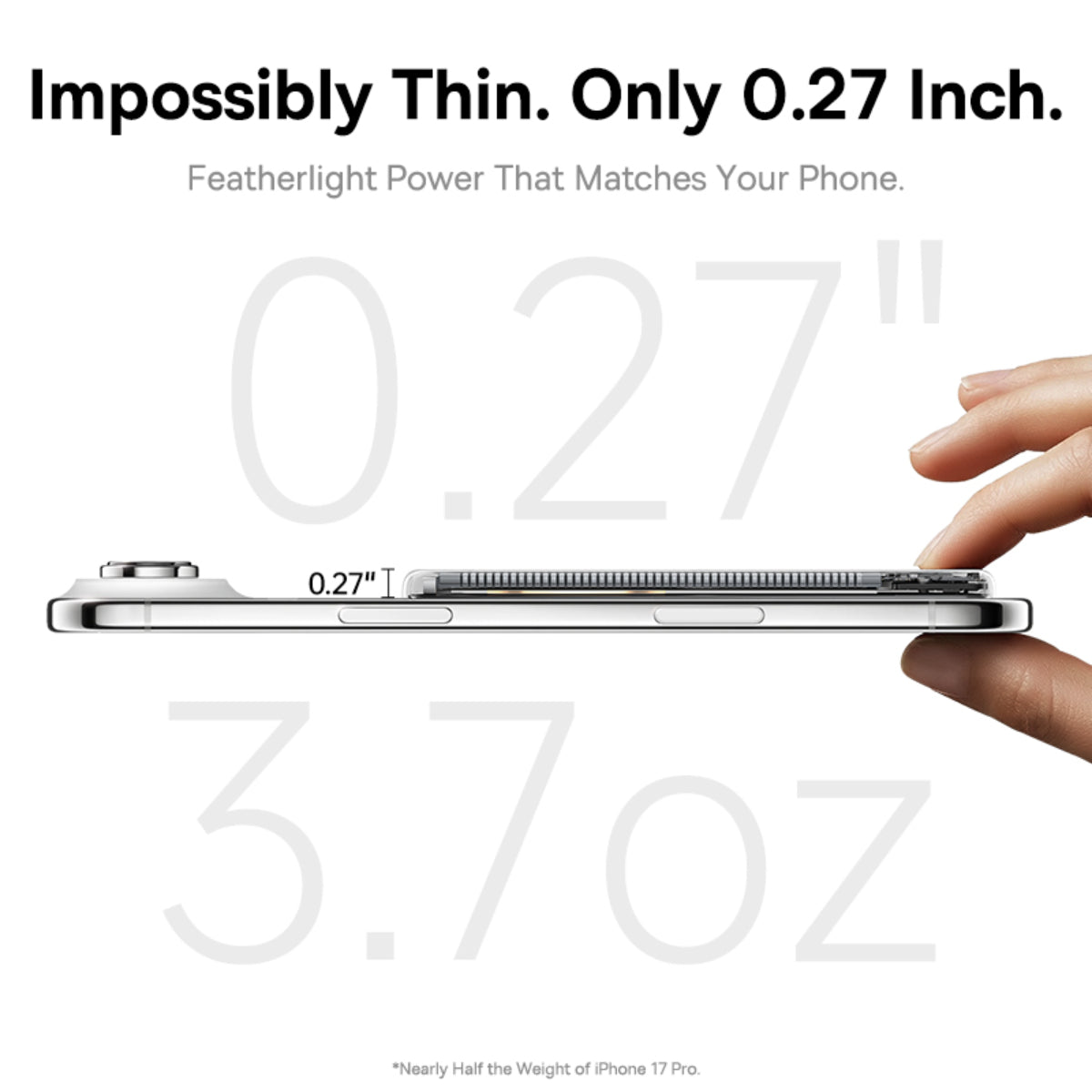
Macworld’s measurements put it at 6.8mm and 105g, making it the lightest magnetic power bank in that publication’s comparison. Macworld also calculated that the average 5,000mAh magnetic power bank in its comparison was around 10.3mm thick. Notebookcheck measured the AM71 at 7.0mm, which is close enough to support Baseus’s 6.9mm claim.
That difference is easy to dismiss on a specification sheet, but it matters when the power bank is attached to a phone. A thinner pack is less awkward in the hand, adds less bulk in a trouser pocket and is more likely to be carried before the battery warning appears.
This is where the design and the NFC feature complement each other. The AM71 is meant to be an everyday top-up battery, and the health monitor gives frequent users a way to see how that daily use affects the pack over time.
The compromises: 5,000mAh, modest wireless speed and manual refresh
The slim body comes with predictable trade-offs.
First, 5,000mAh should be treated as top-up capacity, not a guaranteed full phone recharge. Conversion losses mean the energy delivered to a phone is lower than the headline capacity, and wireless charging adds further inefficiency. Android Central’s hands-on assessment found the AM71 more suitable for restoring roughly half the battery of a large iPhone than for a complete refill. Macworld achieved a stronger result in its own controlled test, charging an iPhone 16 Pro from near-empty to 82%, which shows how much the outcome can vary by phone and test conditions.
Second, this 5,000mAh version is not a Qi2.2 power bank. Its strength is portability, not maximum wireless speed. Baseus lists 7.5W magnetic wireless charging in its current PicoGo comparison, while the USB-C port can reach 22.5W. If speed matters more than convenience, use a cable.
Third, the NFC readings are snapshots rather than a live dashboard. You must tap again to refresh them. That keeps the implementation simple, but the app experience would be stronger if historical battery-health and temperature trends were retained clearly over time.
Notebookcheck also reported weaker magnetic grip than some Baseus models with softer silicone contact surfaces and measured a temperature of roughly 41°C during its testing. Those results will vary with the phone, case, ambient temperature and workload, but they are useful reminders that an ultra-thin design does not remove the usual thermal realities of wireless charging.
Who is the Baseus PicoGo Air AM71 for?
The AM71 makes the most sense for:
- commuters who want an emergency top-up without carrying a thick battery pack;
- iPhone users who value a slim magnetic design more than maximum wireless speed;
- travellers who want to check the condition of a power bank before relying on it;
- tech enthusiasts interested in battery temperature and state-of-health data; and
- anyone who normally leaves a larger power bank at home because it is too bulky.
It is a less suitable choice if you want to recharge a large phone fully, charge several devices, or get the fastest available magnetic wireless charging. A 10,000mAh Qi2 or Qi2.2 model will be better for those priorities, although it will be thicker and heavier.
Baseus PicoGo Air AM71 price in Malaysia
At the time of writing on 24 October 2026, the 5,000mAh AM71 was listed by Baseus’s official Malaysian Shopee store at RM187.90 before additional vouchers. Marketplace pricing changes frequently, so treat that as the current online retail price rather than a permanent recommended retail price.
Readers can check the latest Baseus PicoGo Air AM71 price on Shopee or view the Baseus PicoGo Air AM71 on TikTok Shop. Check that the selected variation is the 5,000mAh PicoGo Air AM71 with NFC PowerSense, because some listings also contain a different 10,000mAh Qi2.2 version.
Affiliate disclosure: The Shopee and TikTok Shop links above are affiliate links. I may earn a commission if you make a purchase through them, at no additional cost to you.
Baseus PicoGo Air AM71 FAQ
What does NFC do on the Baseus PicoGo Air AM71?
NFC opens the AM71 information page in the Baseus app after you tap a compatible phone against the marked area. It provides a snapshot of remaining charge, battery temperature, total usage time and state of health.
Can the Baseus PicoGo Air AM71 monitor battery health?
Yes. The Baseus app reports the AM71 battery’s state of health, which helps show how its usable capability changes with age. The reading is not continuous and must be refreshed with another NFC tap.
Does the 5,000mAh Baseus PicoGo Air AM71 support Qi2.2?
No. The 5,000mAh AM71 reviewed here is designed around its slim 6.9mm body and NFC PowerSense feature. The 10,000mAh Qi2.2 model found in some listings is a different product.
What is the Baseus PicoGo Air AM71 price in Malaysia?
The official Malaysian Shopee listing showed RM187.90 before additional vouchers on 24 October 2026. Marketplace prices can change, so check the selected 5,000mAh NFC PowerSense variation before buying.
Verdict: a power bank that tells you more about itself
The Baseus PicoGo Air AM71 answers my original question in an unexpected way.
Power-bank innovation does not always need to mean more capacity, more ports or a higher wattage number. It can also mean giving the owner better information about the product they already carry.
The AM71’s 6.9mm body makes it unusually easy to keep with a phone. Its 22.5W USB-C output provides a faster option when needed. But NFC battery-health monitoring is the feature that makes it memorable, because it reveals a measurement most power banks ignore.
I would still like faster wireless charging, continuous or historical app data and a clearer distinction between the 5,000mAh and 10,000mAh versions in retail listings. The 5,000mAh capacity also makes this a daily top-up tool rather than an all-day reserve for heavy users.
Even with those limitations, the idea is strong. A power bank should not become less trustworthy simply because its internal condition is invisible. By making battery health easier to check, the Baseus PicoGo Air AM71 offers a more honest form of innovation. I hope this becomes normal rather than exceptional.
For more hands-on product analysis, visit my Tech Reviews.
This article is based on a hands-on demonstration at the Baseus Malaysia office followed by independent research. It is not a long-term endurance test. Specifications and prices were checked on 24 October 2026 and may change.