

When AI Can Write the Esports Assignment, What Should We Grade?
When AI can write the esports assignment, I want to see the reasoning. A proposed classroom exercise and rubric for assessing evidence, trade-offs and revision.
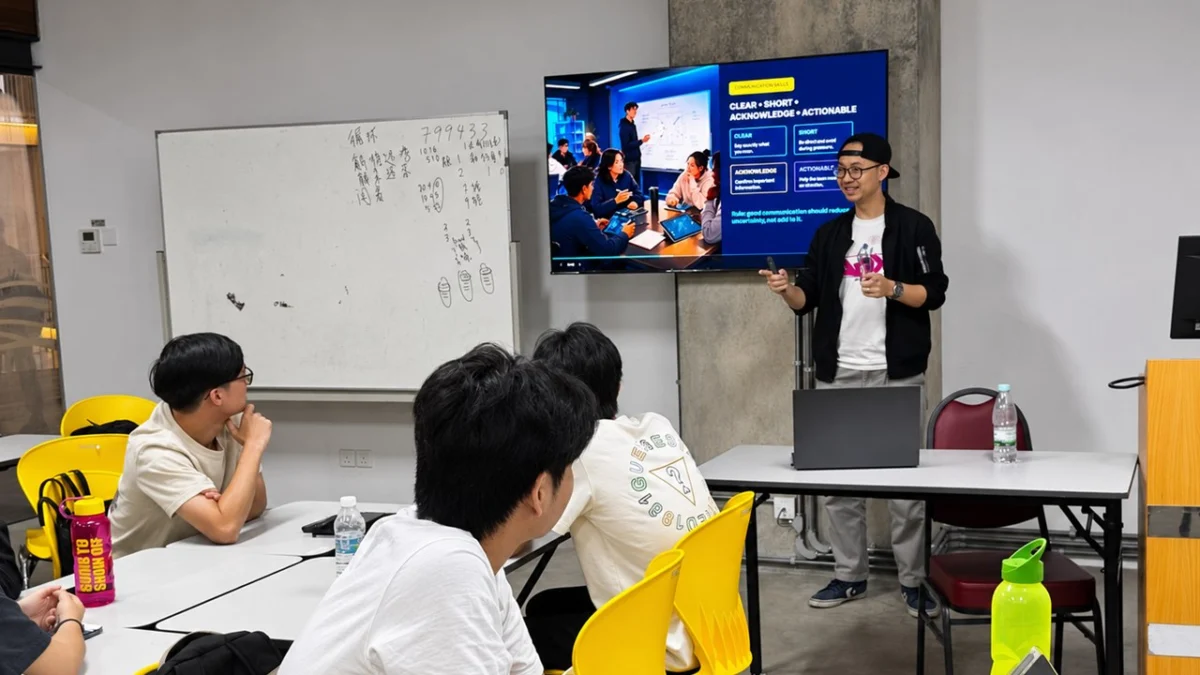
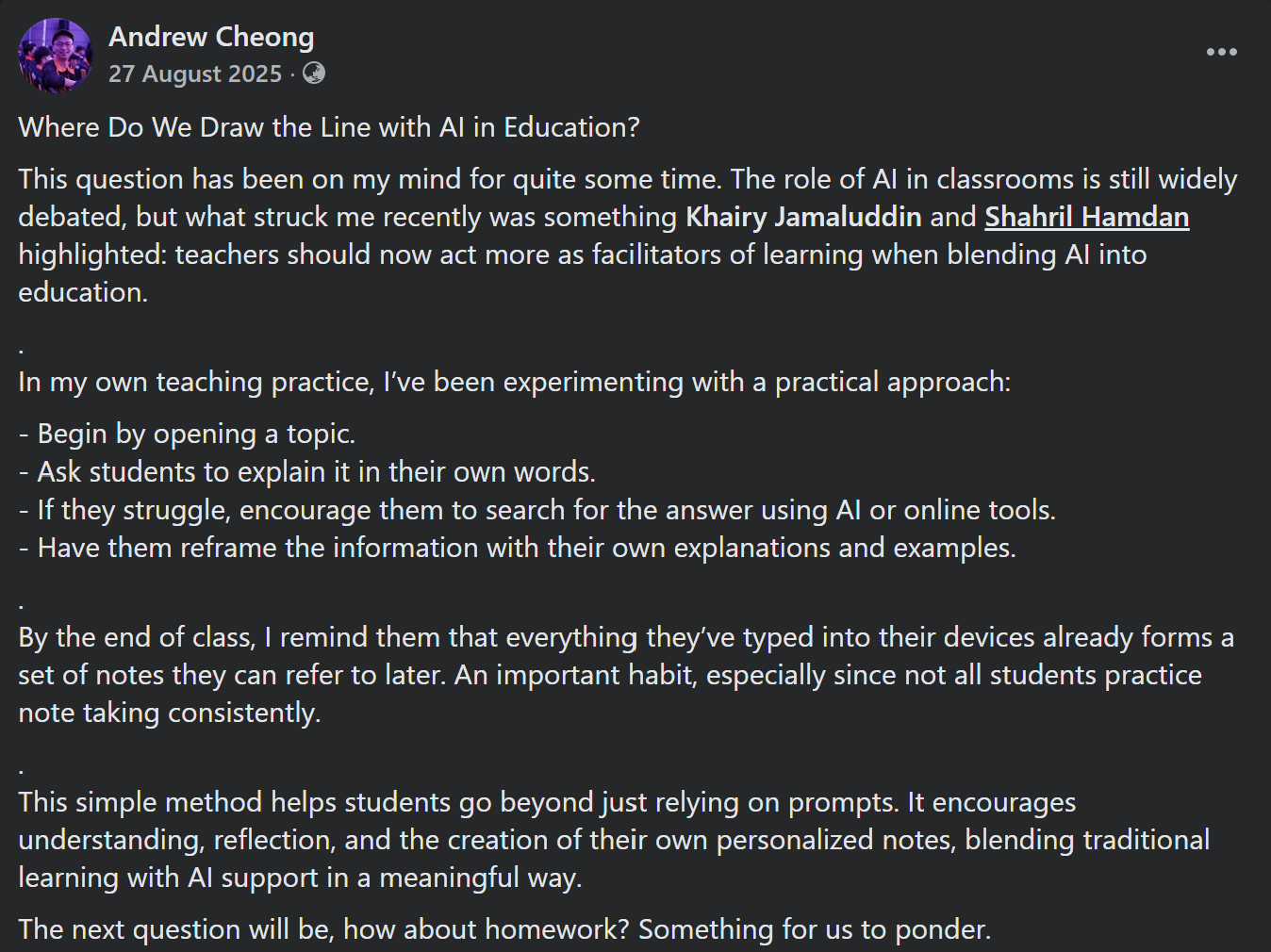
On 27 August 2025, I shared a Facebook post titled “Where Do We Draw the Line with AI in Education?” The question matters even more when AI can produce an esports assignment that reads confidently.
I described starting with an open topic and asking students to explain it in their own words. If they struggled, they could use AI or online tools to explore it. They then needed to reframe the information through their own explanations and examples. The typed material became notes to reflect on, rather than an answer to repeat.
I ended with a question: “The next question will be, how about homework? Something for us to ponder.”
My answer now is that an esports assignment should make the student's use of evidence, judgement and revision visible. A polished final submission gives us only part of that picture.
A Malaysian conversation with classroom consequences
On 19 November 2026, the Ministry of Higher Education's recap of remarks by Higher Education Minister Dr Zambry Abd Kadir connected technological advancement with human values and labour-market needs. It emphasised “pemikiran kritis”, or critical thinking, alongside responsible technology use.
That direction matters to educators. It leaves us with practical decisions about what we ask students to do and what earns marks. The remarks were not an esports assessment policy or a prescribed grading system.
In my teaching, students already choose a recent esports issue, attach a source and write their own response. They also record practice goals and reflect on their development. That existing work gives me a starting point for thinking about assessment.
The clip exercise and rubric below are my proposed extension. I am not presenting them as a tested intervention or TAR UMT policy.
An esports assignment should reveal the reasoning
Changing a sentence into your own words can be useful, but it can also become a paraphrasing exercise. Instead, I want to hear how one observation leads to a conclusion.
Why did the team rotate? What made that route reasonable? Which information was missing? Where does the evidence stop and the student's assumption begin?
Self-explanation offers a useful learning concept here. In a 1994 study, Michelene Chi and colleagues prompted students to explain material to themselves while learning about the circulatory system. The prompted group showed stronger comprehension gains than students who reread the text.
That small study was about school science, not university esports or AI. Its relevance is a design principle: ask learners to explain connections and reasons, rather than merely reproduce information. It does not validate my proposed task.
For an esports assignment, a timestamp helps make that connection inspectable. A student can point to a visible resource shortage, then explain how it changes the options. Another student may choose differently and still offer a defensible answer.
A 20-minute exercise I would try
I would use a short match clip and stop it at a decision point, before showing the outcome. The instructor must distinguish what the acting player or team could know from information visible only to spectators.
A broadcast map can tell us more than the competitors knew. Grading with that extra knowledge would reward hindsight.
Here is one possible 20-minute structure.
- Minutes 0–3: Establish the situation. Show the short clip up to the pause. Provide a plain-language explanation of the objective and essential mechanics, plus captions or a transcript of relevant communication. The context should be enough for students who have little gaming experience.
- Minutes 3–7: Identify the evidence. Ask students to record two relevant observations with timestamps. Separate what is known, what remains uncertain and what is being assumed.
- Minutes 7–12: Make a call. Choose an action, explain why it fits the evidence and identify one realistic alternative. State the risk being accepted. A claim such as “this is the best strategy” needs an explanation of what makes it suitable here.
- Minutes 12–16: Challenge the explanation. Introduce a counterargument or one additional piece of information. If AI is permitted, students could ask it to critique their reasoning, then check its suggestions against the material. A shared teacher-provided AI response is another option when access differs.
- Minutes 16–20: Revise and disclose. Students keep or change their call, explaining what influenced that decision. They briefly record any AI assistance and how they checked it. Choosing to keep a well-supported decision can show learning too.
Therefore, I would keep the first explanation and the revision together. They give the teacher something more useful to discuss than a final answer alone.
What a stronger explanation might sound like
Consider an illustrative, fictional battle-royale scenario. A squad can rotate early with limited supplies or stay for resources under zone pressure. A student could favour moving because the known closing time leaves little margin for a delayed journey. That explanation connects information to a risk; “positioning matters” leaves the connection unstated. If reliable new information showed the intended route was blocked, the student would need to reconsider the route, timing or original call, using what the squad could actually know.
What I would grade in an esports assignment
I would start with this illustrative 100-point analytic rubric, then adapt it to the actual learning outcomes and course policy.
| Criterion | Marks | Evidence |
|---|---|---|
| Evidence | 30 | Relevant, accurately interpreted observations, traceable timestamps and a clear distinction between evidence and assumption. More references would not automatically mean more marks. |
| Reasoning | 30 | A logical connection between the information available and the chosen action, including important uncertainties and constraints. |
| Alternatives and trade-offs | 20 | A realistic alternative and a fair explanation of what each option gains, risks or gives up. |
| Revision | 10 | An explanation of how feedback or new information affected the decision. Marks should reward thoughtful evaluation, whether the student changes the call or retains it. |
| Clear communication and AI-use disclosure | 10 | An understandable explanation and a concise, accurate account of any AI assistance. A student who used no AI should simply say so. |
| Total | 100 | Adapt to the stated learning outcomes and course policy. |
These weights are a proposal, not a research finding. The teacher should share the criteria beforehand and establish what stronger or weaker work looks like.
I would grade the decision using information available at the pause. The eventual winner should not decide who gets the marks. A successful play can involve a poor judgement that happened to work; a reasonable decision can fail because the situation changes.
Feedback needs somewhere to go
This is also where formative assessment becomes useful. The review by Paul Black and Dylan Wiliam describes assessment as formative when evidence is used to modify teaching and learning.
However, collecting a reflection does not automatically achieve that. The teacher and student need to do something with what the task reveals.
For example, if several students mistake a spectator's information for a player's knowledge, I would revisit that distinction. If someone lists observations without explaining their importance, the next prompt should ask for the missing connection.
A short follow-up could ask: which assumption mattered most, and what evidence would make you reconsider it?
Everyone could respond briefly in writing, with an accessible spoken or recorded alternative where appropriate. The teacher could then hold a short conversation when clarification is needed. The format should fit the learning objective, rather than turn every exercise into a test of confidence under questioning.
AI in esports education needs clear boundaries
An AI tool can produce timestamps, plausible trade-offs and reflective language. It can also invent details. Asking for a process does not make an esports assignment immune to outsourcing.
I would look across several pieces of work: the observed activity, initial explanation, checked evidence, revision and follow-up. Together, these provide more context for judging learning. They still do not constitute a reliable AI detector.
TEQSA's expert discussion paper on assessment reform recommends considering multiple assessment approaches, learning outcomes and inclusion in responding to AI. It is Australian guidance, not Malaysian institutional policy, but its caution against relying on a single solution is useful.
Students also need clear boundaries. What assistance is permitted? Which uses must be acknowledged? What material may be uploaded? These decisions should follow the institution's rules and respect other people's information.
Fairness belongs in the design
If I am assessing decision-making, polished English should not quietly become the main route to a high score. Clear communication matters because someone else must understand the reasoning. Elaborate vocabulary is a separate issue.
I would provide the necessary game context, an accessible clip alternative and an example of a supported explanation. Students should have comparable opportunities to engage with the task, including a workable option when a particular AI service is unavailable.
Different courses may properly assess language, live presentation or technical execution. The rubric should say so. My proposed exercise focuses on interpreting evidence and explaining a judgement.
The lesson travels beyond esports
A match gives us a visible decision with constraints, uncertainty and consequences. The same habits matter when someone evaluates a news claim, recommends an event plan or explains a workplace choice.
Can they show what they relied on? Do they recognise the limits of that information? How do they respond when circumstances change?
That is what I would want an esports assignment to help students practise.
My August post ended by wondering about homework. I would now begin the next conversation by making the assessment criteria clearer, keeping space for a second attempt and listening closely to how students explain their choices.
Esports assignment questions
Can students use AI for an esports assignment?
That depends on the institution's and assignment's rules. In my proposed exercise, permitted assistance would be disclosed and its suggestions checked against evidence. This proposal does not override course policy.
Do students need to be strong players for this exercise?
The task should provide the game context and accessible materials needed to assess reasoning. Competitive rank should not determine marks when gameplay skill is not the stated learning outcome.
Can this rubric prove that a student did not use AI?
No. It is a proposed way to examine evidence, reasoning and revision. AI can generate those features too. Multiple assessment opportunities and appropriate follow-up provide context, not proof of authorship.
Andrew Cheong · Sir Cloud
Learning through esports.
I’m an esports educator, commentator and creator based in Malaysia.